
Semiconductor Manufacturing Equipment Export Controls
Semiconductor manufacturing equipment (SME) refers to the variety of machines and components that make modern chips. Export controls on SME have significantly set back China’s AI chip making efforts, underpinning a strong US advantage in AI infrastructure.
What is semiconductor manufacturing equipment?
All modern electronics are made using SME. Making an advanced chip requires hundreds of different process steps, using dozens of distinct machines. A thin silicon disk known as a wafer is moved between these machines, having material added and taken away to construct complex patterns of wires and circuits, in a semiconductor fabrication plant (“fab”). These machines are supplied by an extraordinarily complex and capital-intensive supply chain spanning the US, Europe and East Asia.
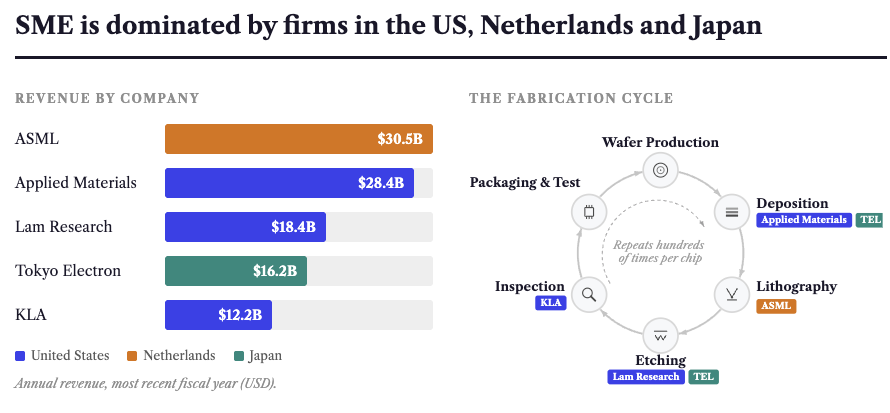
SME makes up 70-80% of the $10-20 billion cost of building a new semiconductor fab, as single machines can range from $5-10 million up to nearly $400 million for extreme ultraviolet (EUV) lithography machines made exclusively by the Dutch company ASML.
Without access to crucial SME China cannot match the kinds of chips being produced by NVIDIA or Google in either quality or quantity. Computing power is essential to AI, as more compute means an ability to train better AI models for commercial and military applications, including software engineering and cyber warfare, as well as to deploy these models at scale. China is working to indigenize the entire US-European-Japanese SME supply chain, but so far has succeeded only in matching capabilities in simpler applications such as packaging and testing chips, relying still on stockpiled imports for more complex steps such as lithography.
What controls currently exist on SME?
SME has long been recognised as a strategic asset. It was first controlled during the Cold War, and those controls carried over into the multilateral Wassenaar Arrangement in 1996. In 2019, the Trump administration persuaded the Dutch government to block sales of EUV lithography machines to China. The October 2022 rule by the Bureau of Industry and Security (BIS) then significantly expanded the types of equipment that were controlled.
Today the restrictions take a range of overlapping forms:
Specific items are restricted, for instance EUV lithography machines or advanced machines for etching and deposition. Any exports of these advanced machines need a license from BIS.
Certain buyers are restricted, for instance those on the entity list such as Huawei. Export of any equipment to these end users requires a license from BIS.
Types of end use are restricted. Most notably advanced AI chips and the development of SME itself. Because of this, a license would be needed to export a machine if BIS was concerned the importing firm was likely to use the machine to make advanced chips.
The Foreign Direct Product Rule (FDPR) allows the US to control SME produced in foreign countries if it was produced using any US technology, software or tools. For instance a Japanese producer would need a BIS license to ship a relevant SME tool to China, if it used US machines, software or chips to make that tool.
The Wassenaar Arrangement, a multilateral export control regime that covers SME. Wassenaar incorporates more than forty states, including Russia. Because it requires consensus, Russia’s membership limits its scope for new controls.
US allies such as Japan and the Netherlands have put in place their own SME export control frameworks.
The SME controls are highly effective, but have some gaps
SME controls have significantly limited China’s domestic chip production. In 2026 China is set to domestically produce a total of AI chips that is only 1-2% of the amount produced by US companies. By cutting China off from the most advanced capabilities, it forces them to pursue trickier and more expensive paths to produce chips at scale. By utilising older machines, and adopting less efficient processes, China can produce some AI chips but at lower quality, and in lower quantities. Access to SME is the key variable that could allow China to catch up in AI.
Given the impact the controls have had, Chinese firms have worked to take advantage of what loopholes they can. For instance Huawei has used sprawling networks of affiliated companies to circumvent end-user controls and access older but still highly capable ASML deep ultraviolet immersion (DUVi) lithography machines that are still allowed into China. Enforcement is challenging for BIS in China with inspections requiring permissions from state authorities.
The most effective restrictions have been those on the most advanced SME that have avoided shipment to China entirely, in particular EUV lithography, vital to producing the most cutting edge chips. EUV lithography is a major bottleneck for China, which will require it to match the €6 billion and 17 years of R&D that ASML needed to invest to commercialise the technology at scale. By working closely with the Dutch and Japanese governments the US has successfully denied China the most important tools it needs for its national AI goals.