Strategic Visions in AI Governance: Mapping Pathways to Victory
This report was co-authored by IAPS researchers Oscar Delaney, Maria Kostylew, Oliver Guest, and Peter Wildeford
Executive Summary
What AI policy objectives should one work towards? This depends greatly on one’s strategic vision. Strategic visions are high-level views about how to successfully navigate the transition to a world with powerful AI systems. The strategic visions discussed here particularly aim to address three severe risks: takeover by powerful misaligned AI systems, wars resulting from competitive dynamics around AI, and AI-enabled concentration of power among a small group of people.
The goal of this report is to make the landscape of strategic visions legible. This can help policy entrepreneurs understand how their work fits within different high-level approaches and identify policy objectives that are robust across multiple visions.
We first outline nine distinct strategic visions, discussing their feasibility and how they would address the three covered risks (section B; see Table 1 overleaf). These visions vary along several dimensions, including the type and extent of government involvement, the level of centralization of AI development, and the geopolitical dynamics around powerful AI.
We then discuss the desirability of different policy objectives according to various strategic visions (section C). Some policy objectives, such as improving AI developer cybersecurity, are desirable across almost all strategic visions. However, some objectives are more sensitive to different visions. For example, increasing the U.S.’s lead in advanced AI over China looks less valuable in visions that attempt to preserve an international balance of power.
Finally, we discuss the “cruxes” between the different visions (section D). These are empirical uncertainties that affect how achievable and desirable various strategic visions are, such as the pace of AI progress and how geopolitically transformative AI will be.
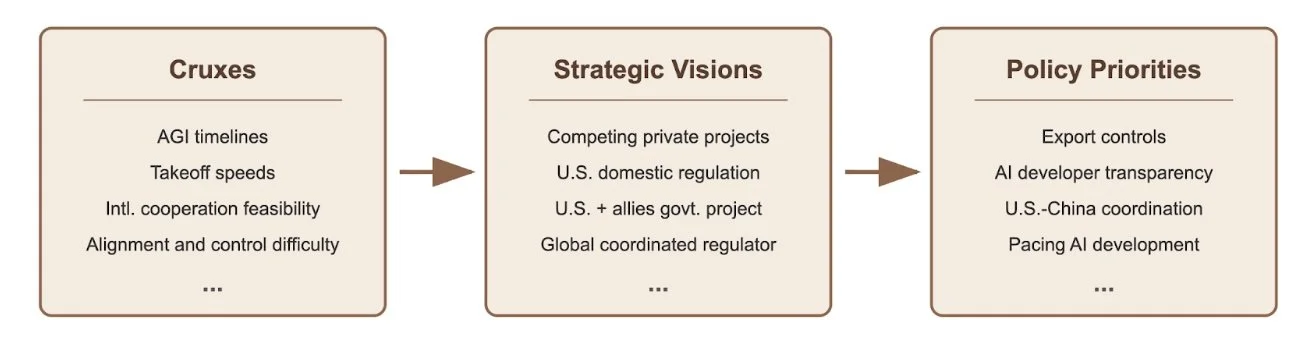
Figure 1: The relationship between cruxes, strategic visions, and policy objectives. Views on key cruxes help determine strategic vision(s) of choice, which in turn inform policy priorities.
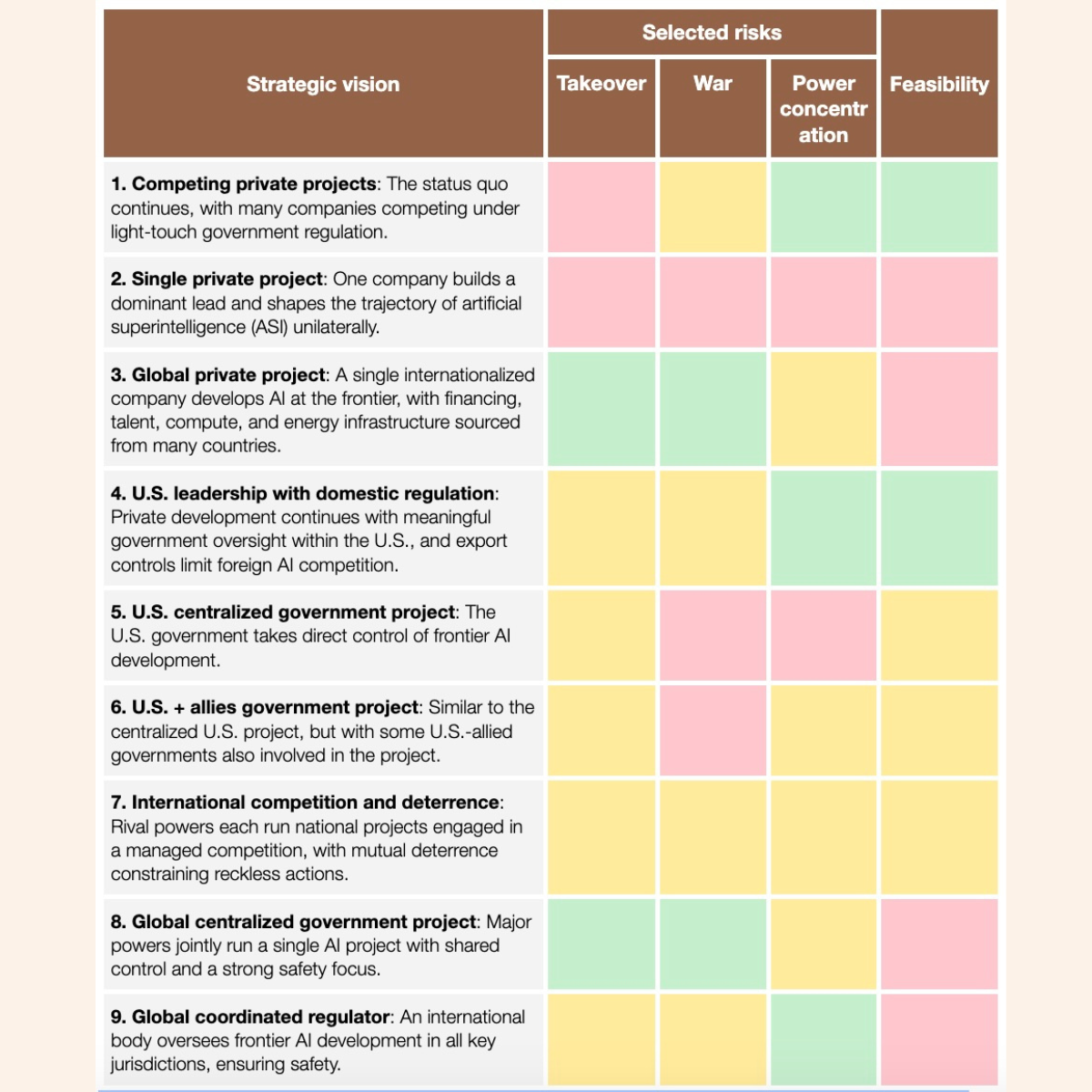
Table 1: Overall subjective ratings of the nine strategic visions. Colors represent the feasibility and effects on key risks for each vision: red is high-risk/low-feasibility, green is low-risk/high-feasibility, and yellow is in-between.