

Compute Policy

About
The Compute Policy team explores novel interventions and strategic considerations for managing access to massive AI compute resources. Current focus areas include:
Technical mechanisms for enforcement of U.S. export controls
Hardware-enabled mechanisms
Information and supply chain security
Featured Research

Location Verification for AI Chips
This report introduces a design for a mechanism that can work on existing chips and verify their location to help enforce export control agreements, while being privacy preserving and reasonably tamper-proof.


Countering AI Chip Smuggling Has Become a National Security Priority
This new report catalogues evidence that substantial quantities of advanced artificial intelligence (AI) chips are being smuggled into China, undermining U.S. national security.
Accelerating AI Data Center Security
AI systems are advancing at breakneck speed and already reshaping markets, geopolitics, and the priorities of governments. This report reviews the security of AI data centers housing frontier AI systems, which are potential targets for sophisticated adversaries like China and Russia seeking to steal IP or sabotage infrastructure.





Understanding Compute Policy
-
How AI Chips Are Made
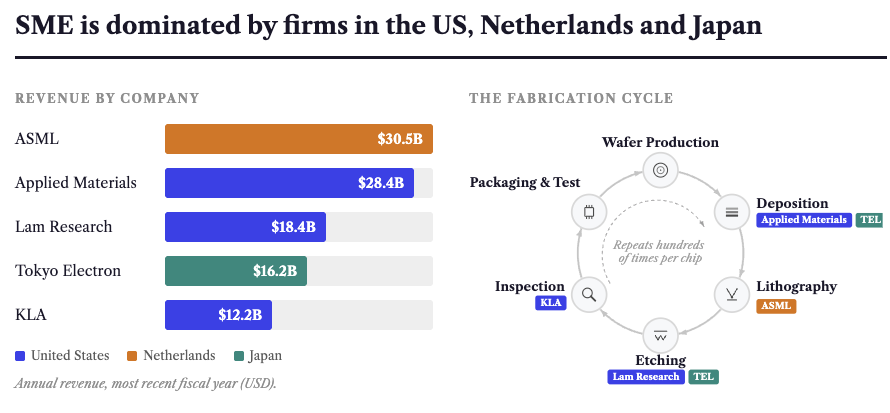
Over the past decade, advances in AI have been driven by the use of more and more sophisticated AI hardware. This blog post introduces the core concepts and background information needed to understand the AI chip-making process.
-
Compute is a Strategic Resource
Computational power (“compute”) is a strategic resource in the way that oil and steel production capacity were in the past. Just as oil and steel were and remain strategic resources to some extent, compute is now also a strategic resource of very high importance.
-
Trump’s AI Export Incentive Program Explained
Alongside its AI Action Plan, the Trump administration published an executive order (EO) for Promoting the Export of the American AI Technology Stack. This blog explains the program and how it may be implemented.
-
New BIS Licensing Policy for H200s
On January 13, 2026, BIS released a new licensing policy for exports of the Nvidia H200, and similar AI accelerator chips, to China. This memo analyzes and explains the new policy.
Featured Experts
-

Diego Duchi
ASSOCIATE DIRECTOR
Diego is the Associate Director if the Compute Policy team where he oversees work on compute governance. Previously was Head of AI Policy at His Majesty’s Treasury, advising the Chancellor of the Exchequer on economics, national security, and artificial intelligence.
-

Onni Aarne
RESEARCH LEAD
Onni is an expert on location verification. He previously conducted compute governance research at Rethink Priorities and has a BSc in computer science and an MSc in data science from the University of Helsinki.
-

Cassia King
SENIOR RESEARCHER
Cassia is a Senior Researcher on the Compute Policy team at IAPS. Prior to joining IAPS, she served as a Policy Advisor at the U.S. Department of Commerce Office of Information and Communications Technology Services (OICTS) within the Bureau of Industry and Security (BIS).
-

Erich Grunewald
SENIOR RESEARCHER
Erich is a Senior Researcher in the Compute Policy team at IAPS. He previously worked as a programmer and earned a BSc in Computer Engineering and an MSc in Interaction Design from Chalmers University of Technology.
-

Hamish Low
RESEARCHER
Hamish is a researcher on the compute policy team at IAPS. Prior to joining IAPS, Hamish took part in the IAPS fellowship and GovAI summer fellowship, and worked as an industry analyst focused on telecoms and tech.
-

Dave Banerjee
RESEARCHER
Dave is a researcher on the compute policy team at IAPS. Prior to joining IAPS, Dave participated in the IAPS fellowship, GovAI summer fellowship, ARENA, and SPAR. Dave holds a B.A. in computer science from Columbia University.
More Research

Curious about IAPS’s work?
Advanced AI systems pose both immense opportunities and complex challenges. IAPS addresses these with practical policy solutions at the intersection of AI policy and national security through in-depth policy research.